 by IntelliMass
Industry & energy · Water, sewer & drainage utilities
The restoration promise is yours. The record of it should be too.
Your crews open the street, a contractor puts it back, and the City's standard decides what "original condition" means. When the complaint comes eighteen months later it comes to the utility — water, wastewater collection, sewer or drainage — because it is your name on the notice. The trucks already driving those streets can build the record: what the public sees driving and walking past your crews and contractors, dated, located, before the trench and after the sod.
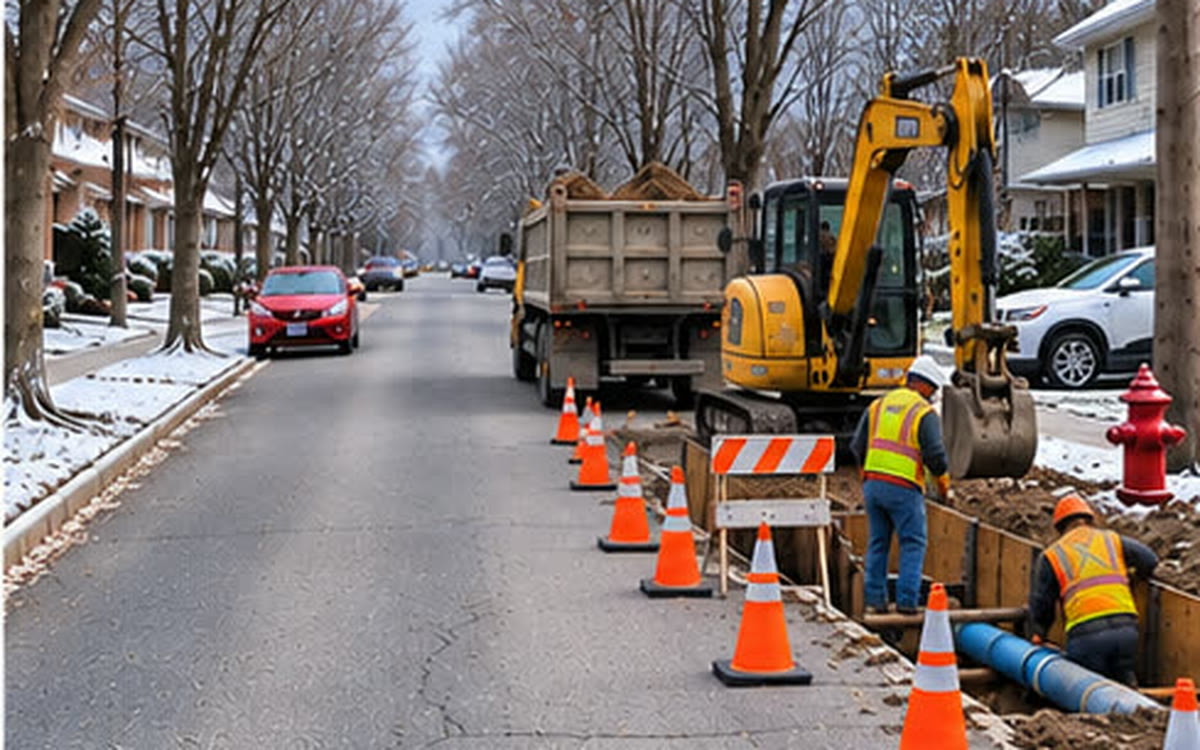
Turn wasted windshield time into the site log nobody has time to write.
Put a phone on the windshield. We combine the driver's spoken notes, recorded only when the driver taps to speak, with the video, slice it by site and date, and link it to your project schedule. Every pass an inspector or supervisor already makes becomes a dated, located entry in that site's log, from pre-work to post-restoration, and at the end of the program, evidence of progress and completion that a contractor, an adjuster and a council can all read.
Nothing to install. Every pass is dated, located video, whether or not anyone remembered to take a photo. The camera doesn't get busy.
"Apron already cracked before we mobilized." One tap, speak, done, in the truck or out of it. Every note and photo is linked to the place and the time it was taken and sits on the video of that pass. No audio is captured unless the driver starts it; the cab is not recorded. A site-visit log, without the visit.
Clips cut by site and date and filed to the stage the schedule says that street was in: pre-work, in progress, restoration, post-restoration. Progress and completion you can show, not describe.
Three parts, on the trucks you already run.
Together they make one record per street, on a hosted page your people can open from a phone.
Video capture
Our app on a phone on the windshield. Every pass by a program street is filed by street and date, whether or not anyone thought to take a picture.
Driver annotation
One tap, speak, done. The note is transcribed, catalogued by what it describes, and pinned to the spot on the video where it was said. Action items can be routed to your other systems.
Road-condition sensor optional
Detect rough pavement just by driving on it. A hitch-mounted sensor scores the surface on the same drives: before the work, after restoration, and months later as the patch settles.
The before exists. Nobody can find it.
The notice on the door says lawns, boulevards, sidewalks and streets will be restored to their original condition. Somewhere there is a before: a pre-construction survey of the block you worried about, photos on an inspector's phone, a contractor's folder, CCTV of the inside of the pipe. What there isn't is one place where the frontage at a given address can be pulled up for the day before mobilization, the week the street was open, the winter under a temporary patch and the June the sod went down. When a resident says the driveway apron was fine before you came, the evidence is scattered across people and devices, and the one who took it may have moved on. The file should hold a date and a view, in order, findable by address. And it should carry the driver's own words on the footage, at the metre they were spoken, which is what turns a folder of clips into a site log. We know of no other system that files the inspector's spoken report on the video of the pass it was made on.
Neighbourhood renewal, sewer separation, flood mitigation, main replacement, service connections. Your name on the notice, your customer on the phone, your adjuster on the claim.
Paving, curb and gutter, sidewalk, sod: usually a separate contractor from the one who dug, often the following season, carrying a warranty you have to be able to call.
Its landscaping and roadway standards decide what "restored" means, its inspector accepts the cut, and it charges for the road life every cut takes.
What the record gives you.
Not a one-time survey of the block you expect trouble on. Every street in the program, dated, before the first truck mobilizes, captured because somebody drove it.
Pre-work, in progress, restoration, post-restoration: the same address, pass after pass, in order, captured on windshield time you are already paying for. Nobody is sent to take the picture.
The paving and landscape contractor's work checked against the record rather than the invoice, and checked again inside the warranty period while they are still on the hook.
When the complaint comes, pull up that address on that date. The site meeting with the owner, the contractor and the insurer starts from a view, not a recollection.
Every cut you open in someone else's street is a restoration you warrant. See the temporary patch still there in June and the settled edge at month twelve before the City's inspector or a resident does.
In-house crews, restoration contractors and developer-built mains on the same record, in the same format, findable the same way. One standard beats a folder per contractor.
This does not replace the inspector, the pre-construction survey or the CCTV report. It is the record between them: the surface, on the dates nobody was assigned to look at it.
In the field.
Three things the restoration promise covers above grade, and what each one looks like from the lane when it isn't holding.
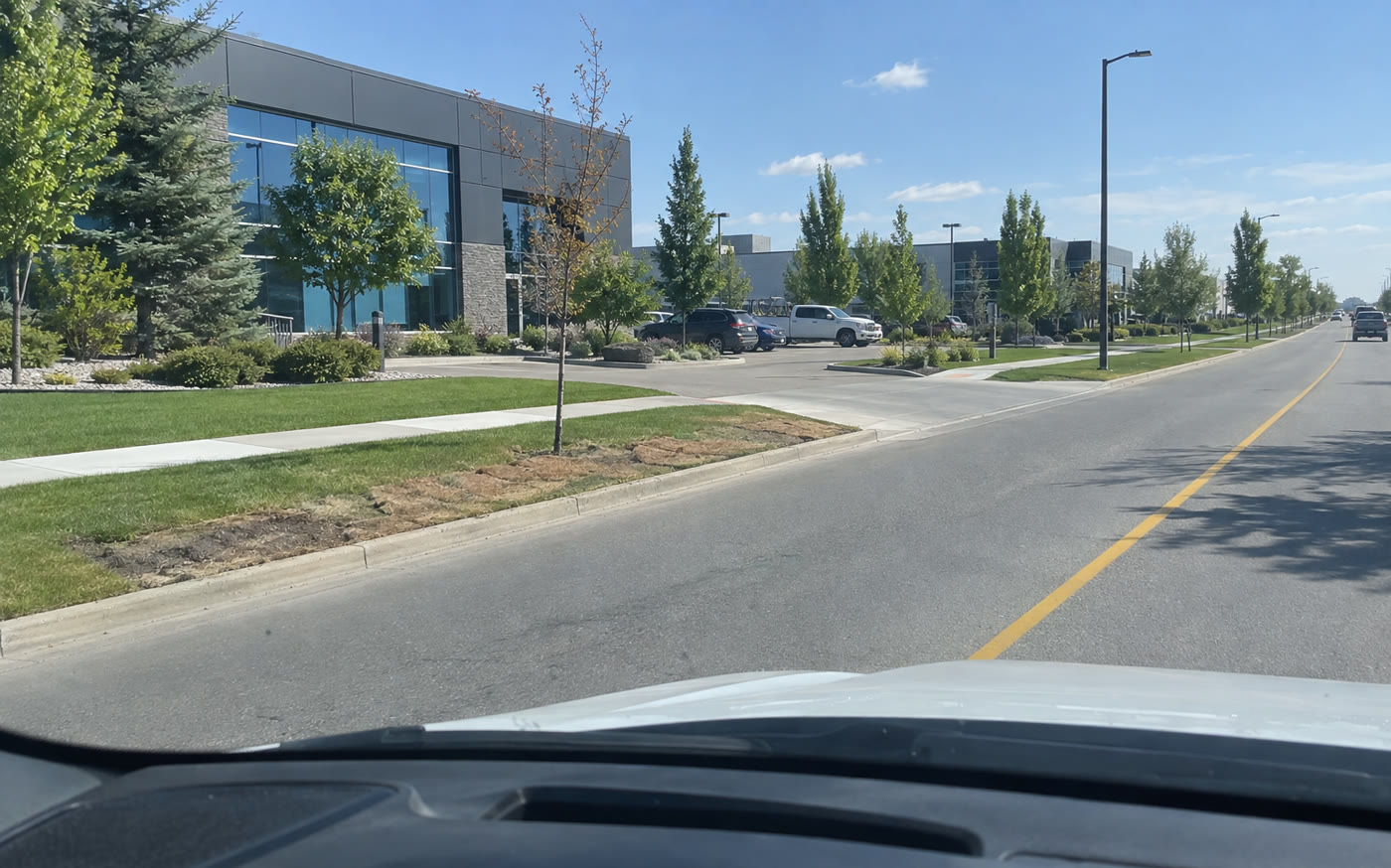
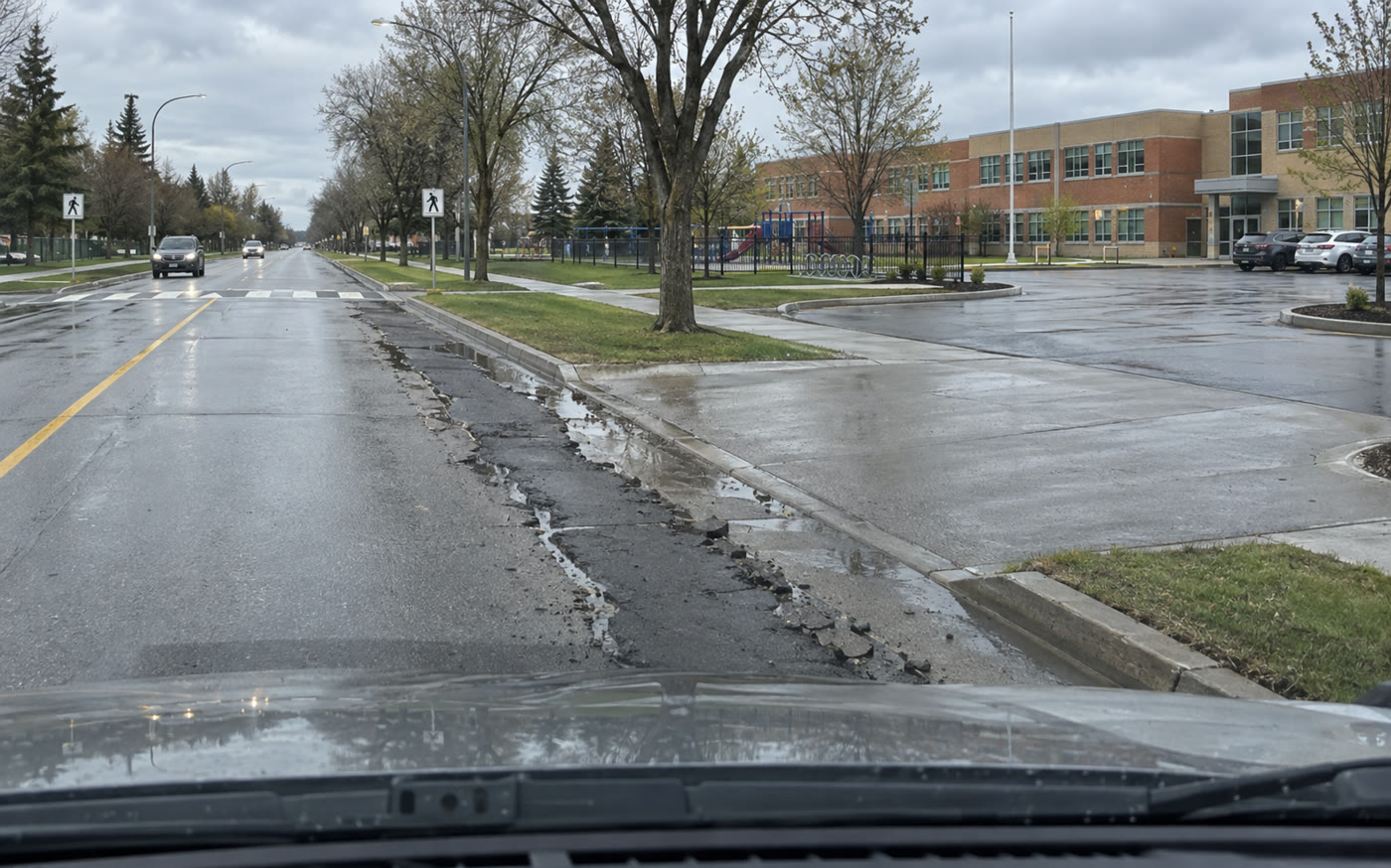
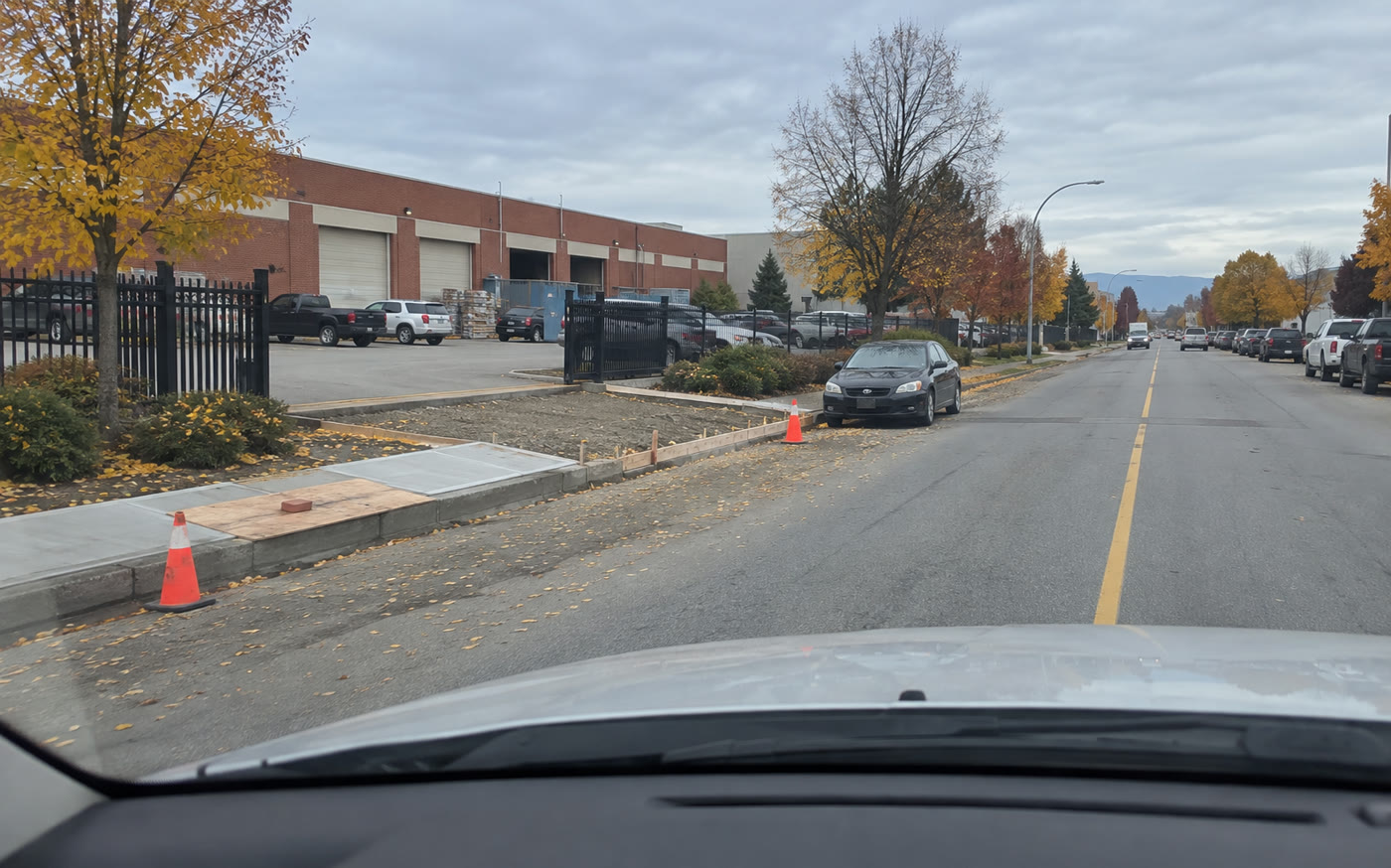
The same street, four passes across a repair.
One residential street, a main replaced along the east lane, from the same point on each pass. Nobody was sent to photograph it. A truck that had reason to be on that street drove past, on each of these dates, and the record kept the frame.
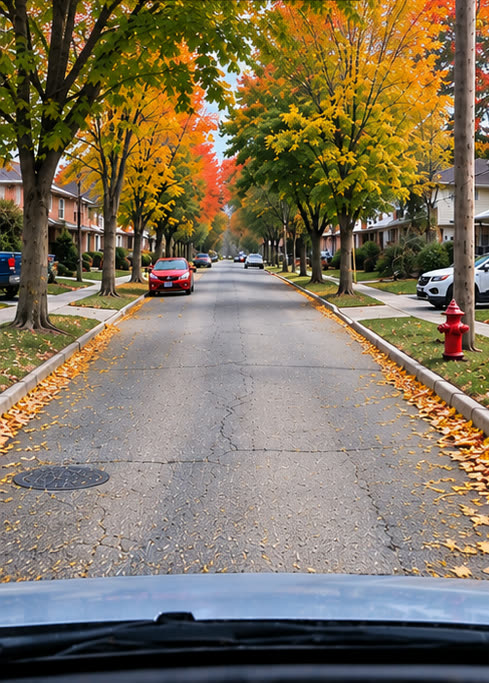
Older asphalt, a crack down the lane, sidewalk and aprons intact. This is the frame every later question is measured against.
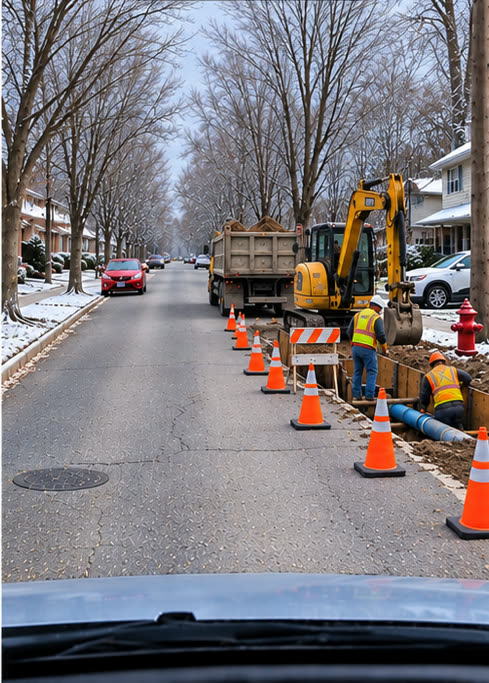
Cones down the lane, trench open, pipe going in. On the record the day it was driven, and every day the street stayed like this.
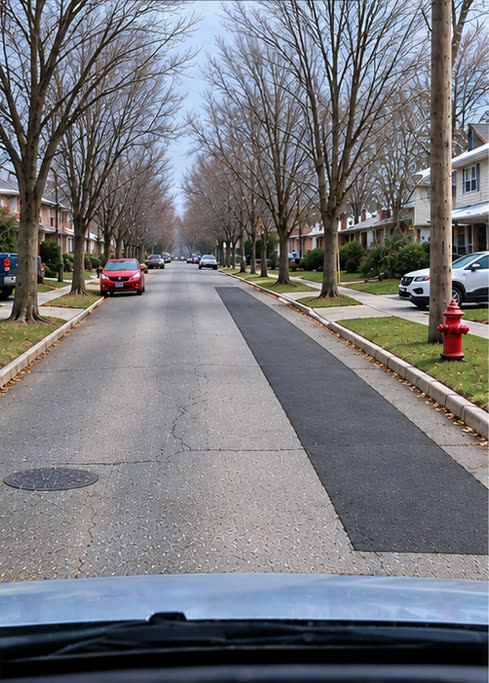
Flush and sealed the whole length. The warranty clock starts here, and so does the claim if it ever comes to one.
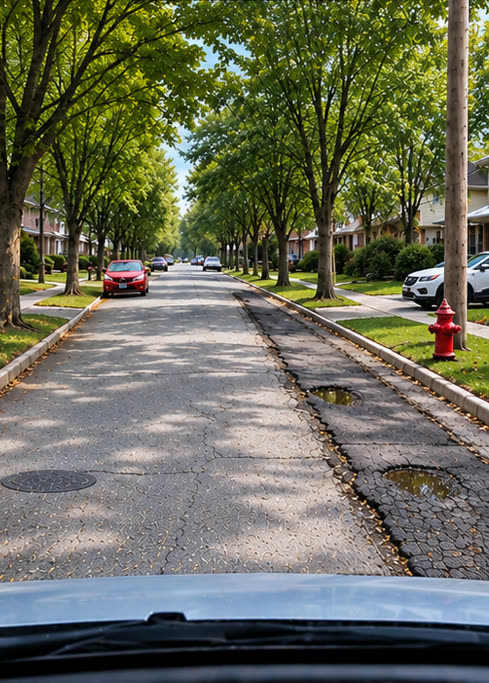
Edge breaking up, water holding along the seam. Seen from the truck, still inside the warranty, before the City or a resident calls.
Illustrative prototype. Production records open as hosted, view-only pages on a phone, no login.
See more months: the fix, verifiedmonth six to month thirteen, same street
Month six to month thirteen: the fix, verified.
Every cut you open in a City street is a restoration you warrant, usually for two years, usually through a paving contractor, on a road someone else owns. The same street, continued: at month six the record showed the patch dropping. The contractor came back at month seven, on their warranty, and the same drives kept watching, at month ten and month thirteen. Nobody was sent.
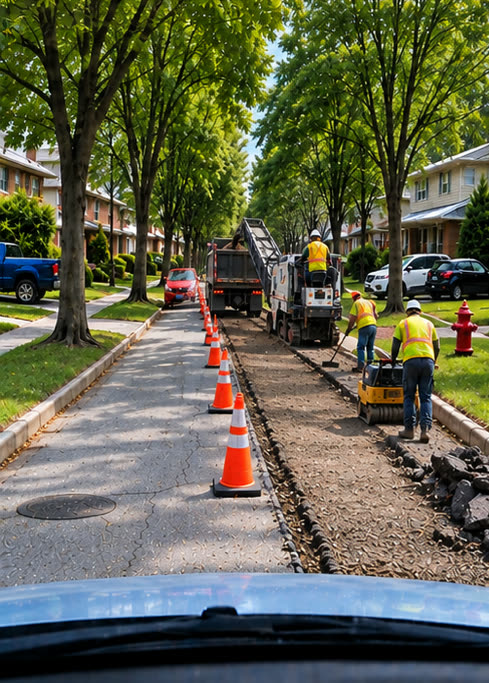
The failed section milled out and rebuilt by the contractor, at their cost. The date the call was made is on the record too.
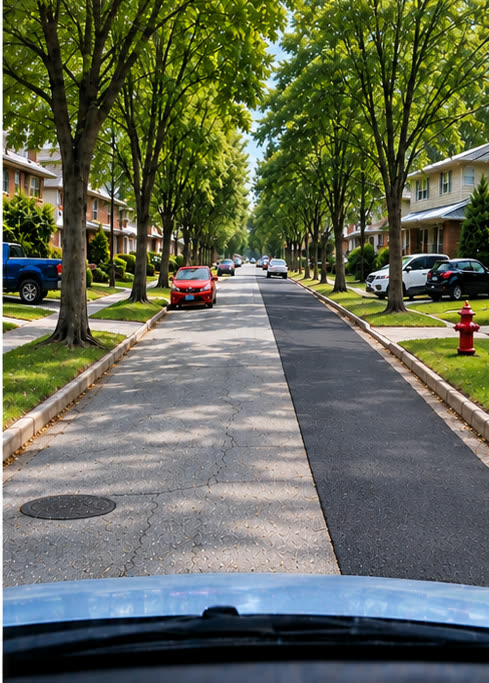
Full length, sealed. A new frame to measure the next months against, without a second site visit.
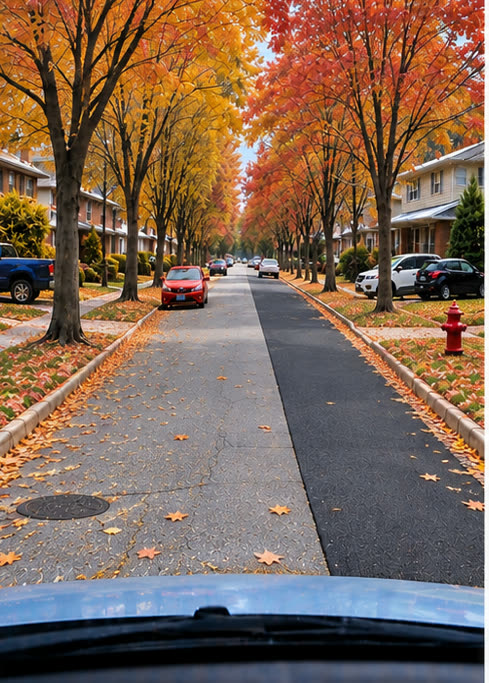
Seams tight, no drop. Verified from the truck on a drive that was happening anyway.
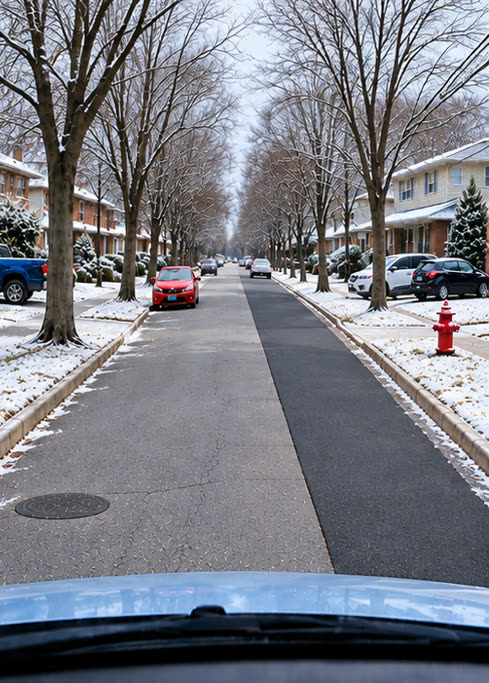
Still flush a year on. The warranty file closes with frames, not a phone call.
We record the cut. We don't measure the settlement or rate the pavement; the City's inspector and its fee schedule do that. With the hitch kit on the truck, the same passes also score the roughness of the restored lane before and after (see Additional options). If you are the road owner rather than the permit holder, the same frames are your side of the story, see Towns & municipalities.
The restored frontage, on every pass.
The promise a utility makes isn't about the trench. It's about what's around it: streets, alleys, sidewalks, lawns, boulevards and landscaping. From the lane, the camera is looking straight at that strip — the curb and gutter, the sidewalk panels, the boulevard sod, the driveway apron — on every pass, without anyone being sent to look. Paving is a warranty question. Sod is an establishment question: placed in September, judged in June, often by a different contractor the following season. The same drives carry both.
Whether the panel has been replaced or is still under a plywood cover, whether the curb is poured and flush with the gutter, and on what date each of those became true.
Topsoil, sod, and whether it took. The driveway apron before mobilization and after the contractor left — the two frames a resident's complaint turns on.
The sewer's other street. An alley goes on the record the same way a street does, as long as a truck drives it — which is worth deciding when the pilot is scoped.
Your record, in the inspector's own words.
The driver taps once and talks. It is the same device that is recording the video — the Dashcam unit — so the audio and the footage are one capture. The voice note is saved with the moment it was spoken — the point on the street, the time, the speed, the heading — then transcribed, titled and filed into the record at the address it happened. A daily diary gives you a line. A voice gives you what the inspector actually saw, at the metre they saw it.
“Driveway apron at this address already has a crack right across it — we haven’t touched anything on this block yet.”
“Temporary patch here is sitting low, maybe an inch. Not sure if it’s settled or it was placed that way.”
“Sod on the north boulevard hasn’t taken, it’s brown the whole block.”
“Water standing in the open excavation after last night, and I don’t see a pump running.”
One of those isn’t certain, and that is deliberate. “I’m not sure” is a legitimate entry. The record keeps the doubt exactly as it was spoken rather than rounding it into a category — and the next pass over that patch is what settles it.
Tap to talk on the Dashcam device — the same unit recording the video. Audio is captured only while the driver has started a note; there is no cabin microphone running in the background. Hands stay on the wheel, and the note is attached to the address it was spoken at rather than typed into a diary at the end of the day. A photo is tapped the same way.
Every voice note becomes searchable text automatically, so a season of drives is something you can search by street and date, not a pile of audio somebody has to sit and listen to.
The transcript is read for what it describes — a patch, standing water, sod, a cracked apron, a missing cover — and dropped on the map as a titled field report you can filter and pull into the claim file.
The Dashcam device records the same way on the windshield mount or in somebody's hand. A trench you get out to look into, a catch basin you walk over to, a frontage you photograph from the sidewalk — spoken, located and filed into the record exactly like the block you drove past.
The people driving those streets already know things the file doesn’t: which block was patched twice, which contractor’s sod never takes on the north side, which apron was cracked before anyone mobilized. That knowledge normally lives in an inspector’s head and leaves with them. Spoken into the record, it stays with the street.
“Watch this patch on 66 Street through the winter.” Sometimes the inspector isn’t reporting today’s condition — they’re asking the next drive to check something. With the watch option, a spoken note sets a watch from the driver’s seat, named and located as it’s said, then answered on every drive that covers it from then on. No form, no desk, nobody to ask.
Voice capture, automatic transcription and hazard tagging run in the Scout app and platform today. The four notes above are written as examples — the wording is ours, the addresses are placeholders, the format is what a real annotation looks like. Watches, including setting one by voice, are offered as an option on the program.
Your project schedule becomes the watch list.
Every street in the program is already on a schedule: mobilization, open cut, temporary restoration, permanent restoration, warranty. A watch turns each of those streets into a zone with the stages your schedule already has — pre-work, in progress, restoration, post-restoration — and every drive that covers it is filed against the stage the street was in that day. Daily or weekly through the work, then through the warranty. The before, the work and the restoration sort themselves, by address, without anyone tagging a photo. You get it on every drive, for windshield time you are already paying for.
A watched asset
A cut, a manhole, a driveway apron, a boulevard. Named, located, and reported on every time a drive covers it.
A watched zone
A block in the program, taken straight from the schedule: pre-work until the first truck mobilizes, in progress while the street is open, restoration while the contractor puts it back, post-restoration through the warranty year. Named for the street, because that's how the complaint will arrive.
Scoped to the program, not the whole city
For a utility the record matters on known streets on known dates. Watched zones are the scope: video inside them is kept and processed, video outside them is not. We slice the raw drive, pull only the clips the zones need, scrub them, and that is what you review. Storing less is the point, not a limit.
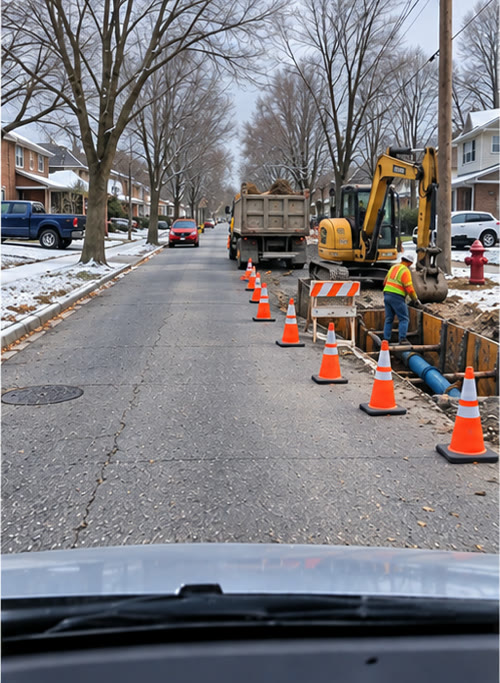
Temporary patch placed. Nothing to do — but now it's a named thing with a question attached: when does the permanent go in?
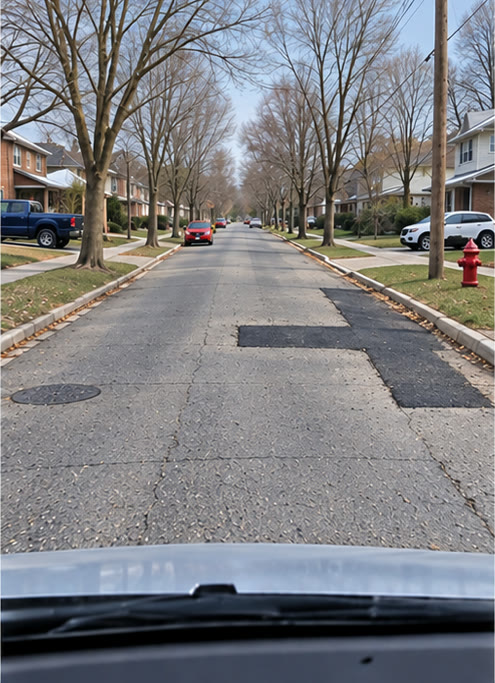
Permanent restoration in, flush and sealed. The warranty clock has a start date with a frame behind it.
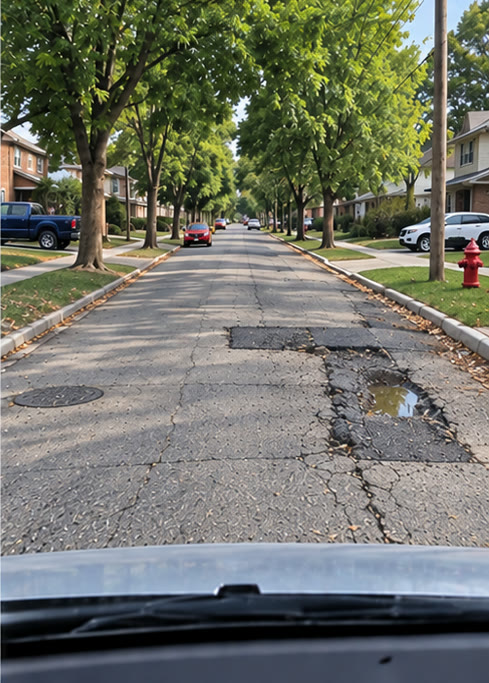
Settling at the edge, month twelve. An email goes out the day the record is published. This is a warranty call to the contractor, not a claim from the City.
The three frames above are an illustration — a worked example of how a watch behaves over successive drives, not a captured record from a utility's program. The box doesn't move. A watch is set on a place, and what changes is what stands inside it. Nobody was sent to inspect this cut — a truck drove past three times on trips it was already making, and the record did the noticing.
| Watch | Scope | Answers | Last event |
|---|---|---|---|
| Watch — 93 Ave, 62 St to 66 St | ZoneNeighbourhood renewal · stage: in progress | Every pass filed to the phase; any change to the surface, the fencing or the open excavation between passes. | 14 Jul · fired |
| Watch — Temporary patches, winter | ZoneSewer separation · whole neighbourhood | Heave, settlement or a patch that has broken up before spring. | 3 Feb · fired |
| Watch — Apron at 6412 | Asset93 Ave · east frontage | Whether the pre-existing crack has changed since mobilization. | 14 Jul · quiet |
| Watch — Sod, north boulevards | Zone94A Ave · east of 62 St | Whether the September sod has taken by June, or needs the contractor back. | 11 Jun · fired |
| Watch — Manhole, 92B alley | AssetAlley storm drainage · 92B Ave | Frame and cover flush with the surface, patch intact around it. | quiet since May |
| Watch — 66 St, restored blocks | ZoneNeighbourhood renewal · stage: post-restoration, months 1–24 | Settlement, edge cracking or sod failure on any restored frontage before the warranty runs out. | quiet since Apr |
Illustrative. Clip extraction from a drive and automatic blurring run in the platform today. Watches, schedule-driven zones with stages, and keeping video only inside them are offered as an option on the program, scoped per deployment. In production, a fired watch emails the record's owner the day it's published.
Crews, contractors and developers, on the same record.
Your own construction crews dig some of it. A paving contractor restores most of it. A developer's contractor builds the mains you will inherit, with your inspector on site. Ask each of them to document the surface and you get a folder per contractor, in a format each chose, indexed however they liked. One record standard across the program — the same capture, the same viewer, the same way of finding an address on a date — is worth more than the sum of those folders, and it is the utility's to hold, because the promise was the utility's to make.
The video and the record are the utility's. Nothing is published, pooled or shared with anyone you haven't named. Records open as hosted, view-only pages for the people you give them to, and a complete copy is yours to take at any time. Audio exists only where a driver chose to speak; there is no cabin-facing camera and no continuous microphone.
Drives, field reports and watches export as KML/KMZ and open in ArcGIS, QGIS or Google Earth beside your as-builts, so the surface record sits next to the pipe record.
If you are the contractor reading this, the same record works from your side: dated proof of what the frontage looked like before you mobilized, and of the restoration you handed back, held in your name for the warranty period. Nobody is watching your crews. The street is on the record, and that protects the party who did the work as much as the party who promised it.
Layer these on when the program needs them.
The record works on its own. These are the pieces a utility adds for a specific program, each quoted per deployment.
Integrate your own video, easilyGoPro · 360 · other dashcams · your cloud storage
You already have footage of these streets: a GoPro on the crew truck, a 360 camera on the inspector's, another dashcam, a phone. We ingest it, pin it to the drive by GPS and date, slice it to the same zones and file it beside the Dashcam record. Footage you hold in your own infrastructure, such as your cloud storage, stays there; the system links to it in place rather than copying it out. Because the record is built by cutting clips out of raw video by place and date, the camera that shot it stops mattering.
Faces and plates blurred automaticallyapplied before anyone reviews the record
Residential streets have residents in them. Automatic blurring of faces and licence plates is applied to the record before it is reviewed, so what your inspectors, your contractors and your adjuster see is the street, not the people on it.
Storage tiers, or your own accountours, sized to the program · or the utility's own cloud
Keep the zone clips on our infrastructure on a storage tier sized to the program, or hold the record in the utility's own cloud account, where the storage is yours, the bill is your provider's, and unlimited footage can be linked to your routes inside the zones. Either way the raw footage is not published, pooled or shared.
Road roughness, before and after restorationhitch-mounted road-health kit
The question a resident, a councillor or your own paving contractor will ask: what was the surface like before you dug, what was it like while the patch was in, and what is it like now? Add the hitch-mounted Scout sensor to the truck and the same passes, at normal driving speed, answer it in the site's own terms: a road-health score for the same street before the work, under the temporary patch, and after the contractor's restoration, compared pass to pass. A defensible answer to "you wrecked my street", and a check on the paving contractor before the warranty runs out. It is a comparative score from a vehicle sensor, not a profilograph run or a pavement condition index, and it doesn't replace your materials testing.
Integration with the systems you already runGIS today · work-order, asset and document systems by integration
Drives, field reports and watches export as KML/KMZ into ArcGIS, QGIS or Google Earth today, beside your as-builts. Where the program needs the record inside the systems you already run — a work-order or asset system, a document repository, a claims file — we build the connection to your environment, scoped and quoted as integration work and maintained by us while it is in place.
Hosted on infrastructure you controlyour account, region and keys
For programs that need the record inside the utility's own environment: deployed to a cloud account in the utility's name, its region and its keys, with the data yours from the first record. A real deployment, quoted per environment.
Bought by the truck, paid for with windshield time.
Phones on the windshield
Our app on the phones of the inspectors and supervisors already driving the program, on the windshield while they drive and in hand on site. Nothing to install. Every street they pass goes on the record, dated and located, with their spoken notes on it. We don't send anyone; your drives are the capture.
Add the hitch-mounted sensor
The Scout road-health sensor on the hitch of the trucks you choose. The same drives then score the restored surface as well as film it: before the work, under the temporary patch, after the contractor's restoration, and months later as the seams settle. A comparative score, not an engineering measurement.
Sized to sit under one manager's signing authority, no procurement cycle. Start with one program and the trucks that already drive it; add trucks, programs and options as the record earns its keep. The record is yours from the first pass.
If nobody on your side drives those streets, we can. A done-for-you record of one program on your interval, fixed fee per program. It's the fallback, not the point: the value is in the drives you already pay for.
What we don't claim.
Tell us which neighbourhood is being dug up this season.
The record is worth the most if it starts before the first truck mobilizes.